WHAT IS DONEXT?

What is DoNext!!?

DoNext!! is an online magazine that imagines possible futures through fictional interviews with the people living in them, grounded in changes happening today.

We do not predict the future. We explore lives and work that do not yet exist to make tomorrow feel like a place with more choices.

An Online Magazine Imagining the Future

FUTURE WORLD / FICTION

2040

ROBOT COMMONS

Someone receiving a drink from a robot at a café in an imagined future

A future in which working physical AI and income from individually or jointly owned robots support everyday life.

3 INTERVIEWSFrom people who own robots to those who use them, build them and preserve culture.

An Online Magazine Imagining the Future

FUTURE WORLD / FICTION

2040

ROBOT COMMONS

In a City Where Robots Work,
What Will People Choose to Do?

A future in which working physical AI and income from individually or jointly owned robots support everyday life.

Two people talking in a café where robots work in an imagined future
Working Robots Support Everyday Life.What Will People Choose to Do with Their Time? 3 INTERVIEWSFrom people who own robots to those who use them, build them and preserve culture.
Explore This World

LATEST STORIES

Latest Stories

All Stories →

FROM WAYFINDER

This Time,
We Visit a Future Where
Working Robots
Support People's Lives.

Machines work in factories and shops. The income they generate reaches the people who own them, individually or together. What do people choose to do in such a world?

Learn to cook. Spend more time on pottery. Keep working. Choose which robot to use next. We visit people who own machines, use them on-site, build them to last, and pass cultural skills on to others.

FUTURE SCENARIO / FICTION — The people are fictional; the future is hypothetical.

WORLD / 01

Even on a Weekday,
Everyone Has Their Own Way to Spend Time.

LIFE / AN ORDINARY WEEKDAY

With Time Gained Back,
What Will You Enjoy?

A weekday street with working robots in shops and people gathering

Robots take orders at shops, while children and parents speak to a mascot-like robot in the park. Even in the middle of a weekday, people are out shopping, enjoying hobbies and taking walks.

In this imagined future, income from working robots supports people's lives, making it easier to choose how to spend their time. Some work fewer hours; others continue doing the work they love.

OWNERSHIP / HOW LIVES ARE SUPPORTED

The Work of Machines
Becomes Income for People.

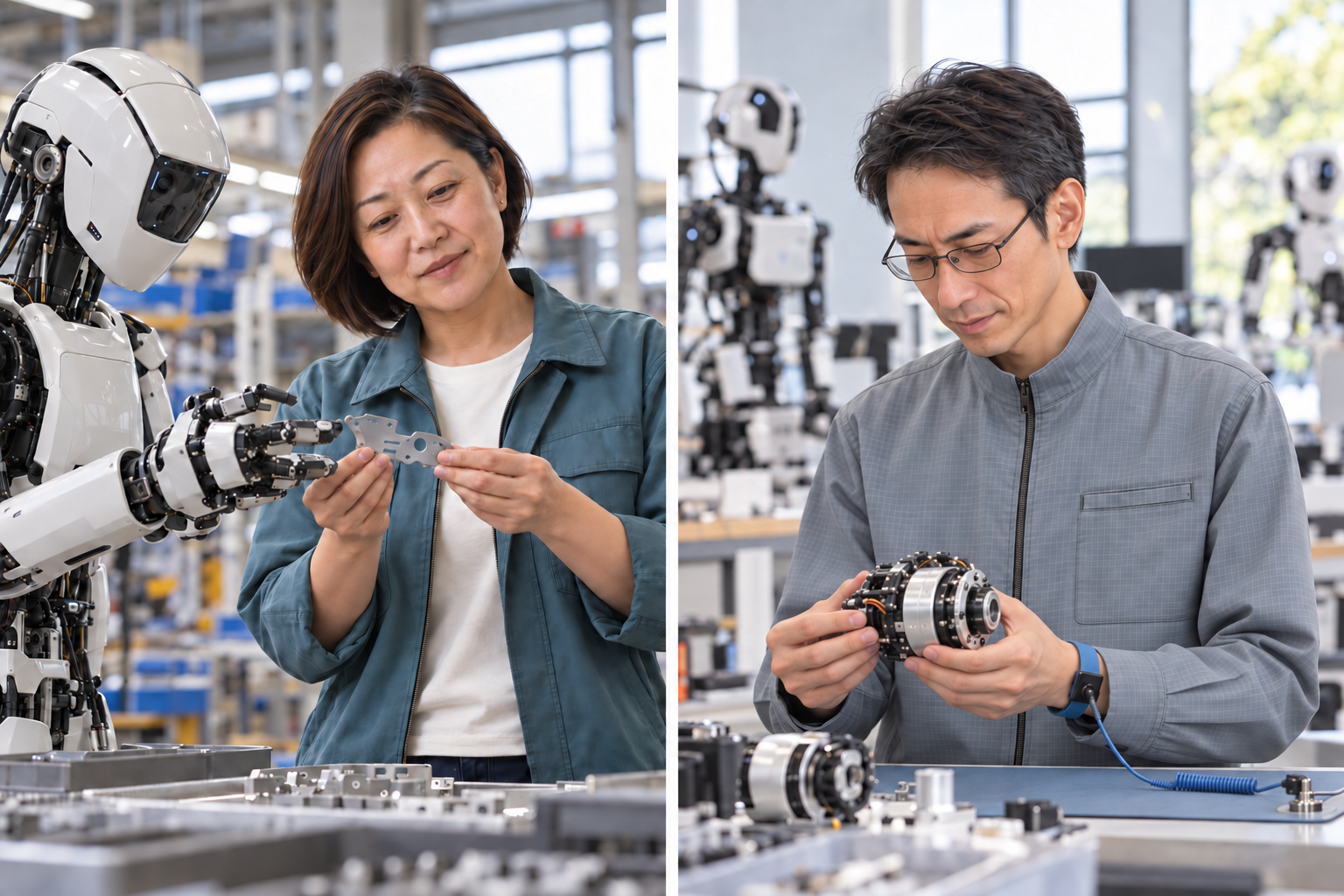
A humanoid robot working in a factory while people discuss maintenance

Capitalism continues in this world. Some people own robots through their companies; others share ownership much as they might join a mutual-aid group. Specialist operators manage jobs and maintenance.

Usage fees cover operation, maintenance, repairs and replacement reserves; the remainder is distributed. Unlike an unconditional equal payment to every citizen, this is a basic-income-like arrangement. Distributions and the value of shares fluctuate, and owners still decide which machines or investments to hold.

CULTURE / TIME TO PASS ON SKILLS

A Dance Once Watched
Can Become One You Learn.

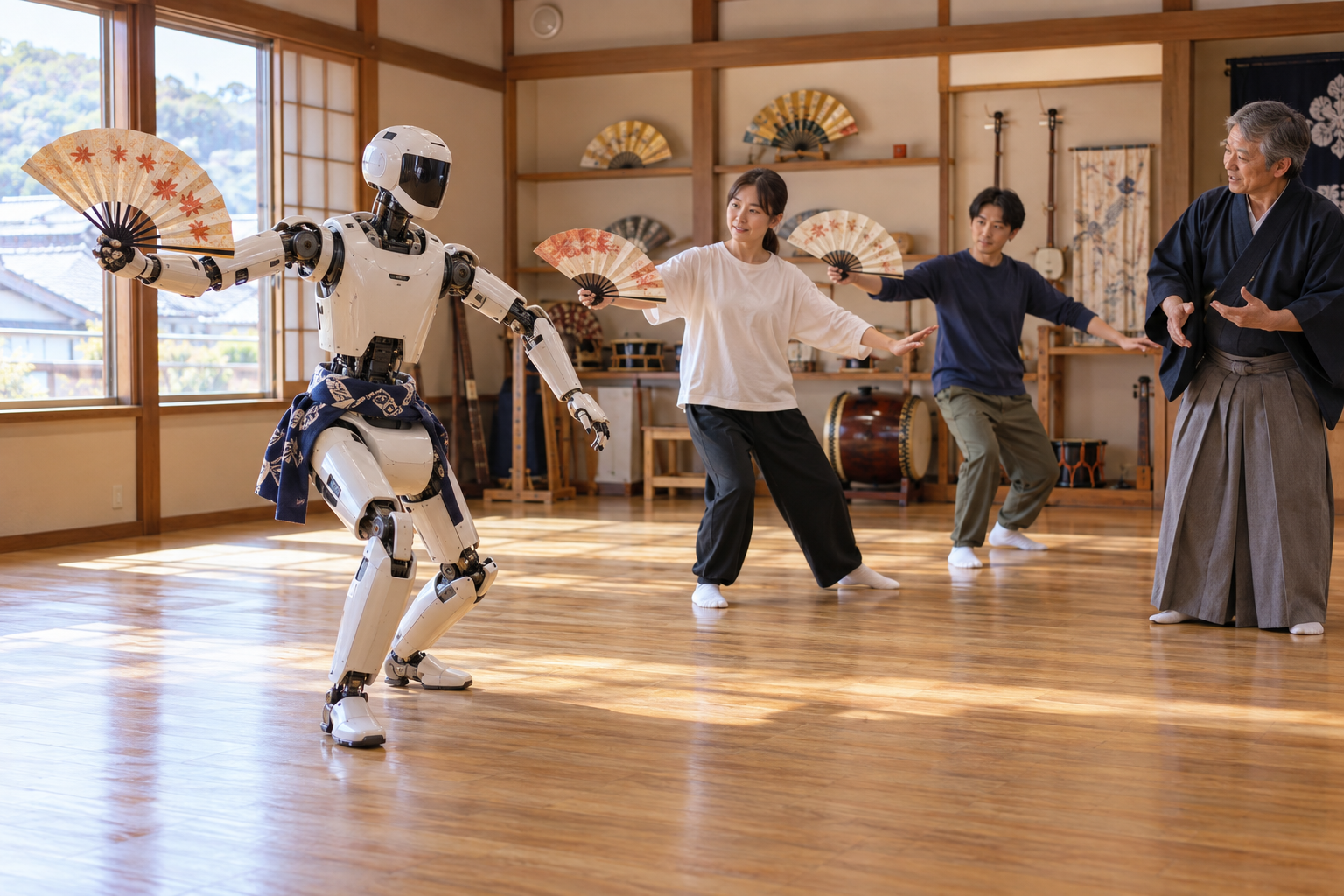
People learning kagura movements from a humanoid robot demonstration

Robots demonstrate kagura movements recorded with performers and preservation groups. Adults and children at the cultural center imitate the footwork and practice again and again.

Skills passed down by people can be shared with a new generation. Someone who once only watched may eventually dance at the main festival.

PRESENCE / GOING OUT WITH SOMEONE YOU MISS

Even If You Are Far Away,
You Can Walk Through Town Together.

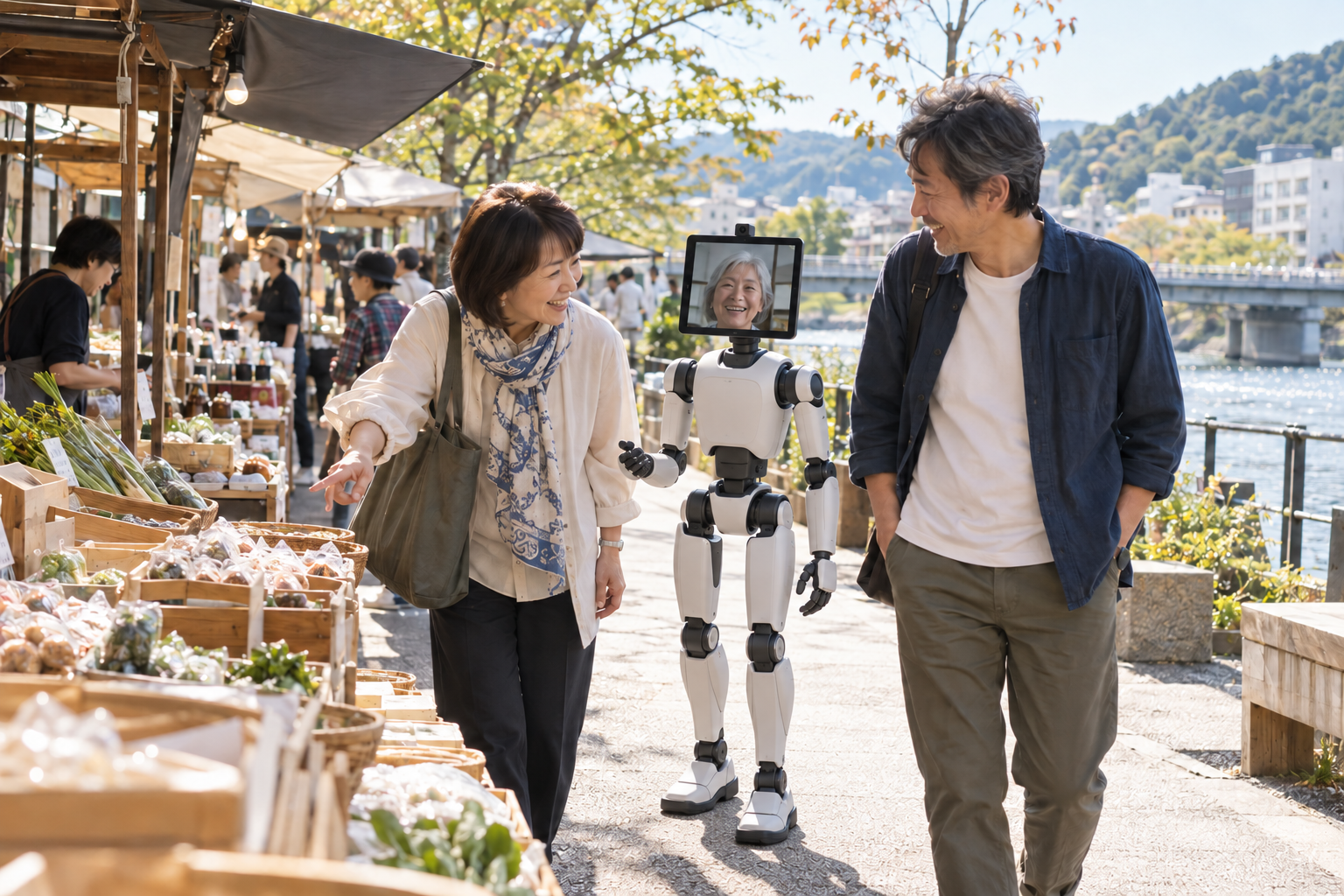
Friends visiting a market through a remotely operated avatar robot

Through a locally rented avatar robot, someone explores the town with a distant friend. They choose shops, talk and look at things that catch their attention.

The friend behind the screen speaks in their own words and chooses where to go. This is a robot operated remotely by a person, not an autonomous shop assistant.

EDITORIAL QUESTION

If Robots
Do the Work for Us,
How Will You Live?
Explore the Assumptions Behind This World →

PEOPLE / INTERVIEWS IN THIS ISSUE

People Living in This Future.

From those who own robots to those who use, build and preserve skills.

REALITY LINK

Real Developments
Behind This Future.

Robots in workplaces, proposals for sharing economic benefits and research into passing on skills all offer clues for imagining this future.

THE IDEA OF SHARED OWNERSHIP

How Could AI and Robotics Profits
Support People's Lives?

In a 2024 interview, Taizo Son described a proposal for 'basic assets': communities jointly owning AI and robots and returning the gains to their members. It treats working machines as assets that can support everyday life.

Source: Toyokeizai Online / 2024 ↗

ROBOTS AT WORK

Humanoid Robots
Begin Working in Logistics.

In 2024, logistics company GXO and robotics developer Agility Robotics announced a contract to deploy Digit, a humanoid robot used for moving freight. These early deployments include services that support day-to-day robot operations at business sites.

Source: Agility Robotics / 2024 ↗

RESEARCH INTO PASSING ON SKILLS

Hand Movements and Sensations
For the Next Generation to Learn.

CrafTouch, a project involving Keio University, records the movements and touch of master potters to help new learners. This feature imagines extending the same principle to passing on kagura dance.

Source: Keio University KMD / 2025 ↗
Explore More of the Real-World Connections →

NOW

What Is Happening Now?

VIEW ALL NOW
AI / WORK / CAREER

Workers likely exposed to AI displacement take longer to find their next job, Goldman Sachs analysis finds

OBSERVED

An economic analysis by Goldman Sachs examined employment histories of more than 15,000 people who lost jobs between 2016 and 2025. Among workers classified as more likely to have been displaced by AI in 2025, the search for a new job took about one month longer than for other laid-off workers, and the share still without work a year later was around 10 percentage points higher. Axios reported the findings on November 3. The analysis did not establish that AI directly caused each dismissal: the link to AI displacement was estimated using job characteristics and adoption patterns.

DONEXT!!

When considering how AI changes work, the number of jobs lost is only part of the story. The time it takes to find another job matters, too. A longer gap in earnings can affect retraining, career choices, and family life. Following what work people move into afterward may reveal as much as counting the jobs that disappear.

AI / MEDIA / LAW

EU court adviser says Gemini's reuse of news articles could infringe publisher rights in some circumstances

OBSERVED

On November 3, an Advocate General of the Court of Justice of the European Union said Google's AI assistant Gemini could, in certain circumstances, infringe press publishers' rights when it retrieves news articles and reuses recognisable parts of their wording in answers. The opinion arose in a dispute involving a Hungarian publisher and Google. It is an Advocate General's non-binding opinion, not a final court ruling. The reported facts themselves are distinct from an article's protected expression, and the use of material to train AI models raises different questions from retrieving and reusing articles in responses.

DONEXT!!

As readers increasingly get news through AI answers rather than visiting the original article, questions grow about how reporting is funded and how its creators are paid. This opinion is one step in a developing debate about access to information and publishers' rights. The court has not issued a final judgment or introduced a general obligation to pay licensing fees.

WORK / LABOUR / TECHNOLOGY

Google UK agrees to give a union access to workplaces covering around 7,000 employees

OBSERVED

On November 2, Google UK and the Prospect trade union reached an agreement allowing the union to communicate with workers and provide information about membership at workplaces covering roughly 7,000 employees. The agreement includes Google's UK operations and YouTube, but not Google DeepMind. It follows new UK workplace access rights and allows the union to hold sessions at Google offices. The figure does not mean that 7,000 employees have joined a union, or that new pay arrangements or conditions for deploying AI have already been negotiated.

DONEXT!!

As AI changes what people do at work, employees also need ways to discuss how work is organised and what conditions apply. The new access agreement at a global technology company is one concrete development in how workers can participate in those decisions.

AI / FINANCE / TRUST

Hong Kong launches Project SAGE to examine identity, authority and responsibility for AI financial agents

OBSERVED

On November 2, the Hong Kong Monetary Authority (HKMA) launched Project SAGE to prepare for financial services in which AI agents may make purchases or payments on behalf of people and businesses. The regulator established an expert group involving financial institutions and technology specialists to explore how agents should be identified, how a person's delegated authority should be checked, how different services should work together, and how consumer protection and liability should be handled. This does not mean that unrestricted AI-operated consumer payments are already available or that new Know Your Agent requirements have become law.

DONEXT!!

Before an AI can reliably handle payments or contracts for someone, banks and other services need ways to establish whether it really has permission and who is responsible when something goes wrong. Hong Kong's initiative offers an early view of the rules being considered before agent-led finance becomes part of everyday life.

PHYSICAL AI / WORK / ROBOTICS

In China, teaching robots how to work is becoming a job of its own

OBSERVED

China’s robotics companies are increasingly recording people’s movements and decisions to train machines for real-world tasks. In a report published on November 2, Reuters interviewed a Spirit AI executive who said the company employs around 1,000 people to record household and industrial work. Another developer described 160,000 hours of training material and said robots were handling orders at two Shanghai pharmacies, with people still checking the medicine. Battery maker CATL has also described robots performing wiring tasks on a production line. Deployment figures and success rates include company claims, however, and this is not evidence that a general-purpose robot can independently perform any job.

DONEXT!!

Putting a robot to work takes more than manufacturing the machine. People must first demonstrate tasks and check whether the robot can perform them safely. As workers’ practical skills become reusable training data, how will the work of teaching, the value of that knowledge, and the tasks assigned to robots change? These early deployments offer a way to follow that transition.

MOBILITY / WORK / POLICY

London trials robotaxis as its mayor calls for powers to limit their numbers

OBSERVED

Since September, Uber and Wayve have offered a limited passenger service in self-driving vehicles in London, with a safety driver still in the front seat. About 24 vehicles from China’s Baidu are also being tested on London roads. Against this backdrop, the mayor called on November 1 for powers to limit future robotaxi numbers, citing congestion, air quality, and the livelihoods of taxi drivers. The request has not become law, and the limited passenger service still uses safety drivers. Plans to launch a fully driverless service and move drivers into roles such as remote supervision remain proposals; those jobs have not yet been created.

DONEXT!!

The work of moving people around a city may eventually encompass vehicle supervision, remote assistance, and decisions about traffic rules—not just driving. London’s trials and policy debate show how questions about the pace of automation and its effect on livelihoods emerge before fully driverless services are widely available.

WATCH THIS FUTURE

Shops where robots work and streets where people gather in an imagined future COMING SOONThis content has not been published yet.

ROBOT COMMONS / 2040

BACK ISSUES

Visit Another Possible Future.

All Future Worlds →
GLOBAL OFFICE cover connecting mountain life with work around the world

2035 / GLOBAL OFFICE

Speaking Japanese,
Working with Teams Worldwide.

In a world of AI translation and virtual offices, people no longer have to live somewhere just to work there.

Four Interviews

Explore This World →

There are still more lives to visit in this town.

Back to This Issue's Interviews ↑